

-
-
-
News Updates
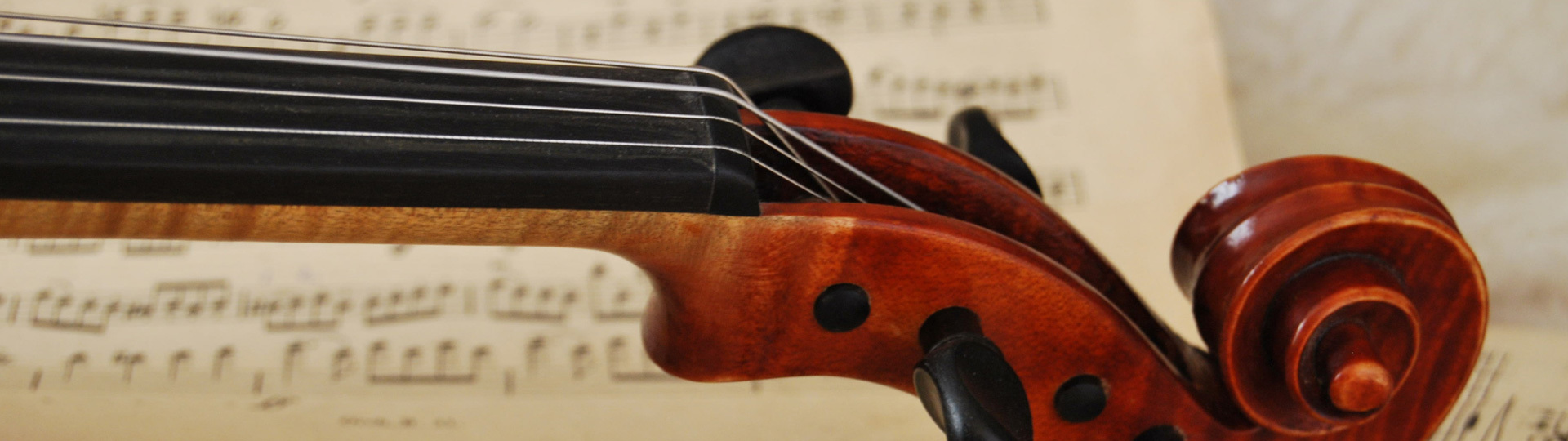
Witnessing the pure hearts of generations of musicians.
Release date:
2023-05-25 14:04
Author:
This is a violin with an 85-year history, its body marked by the patina of time yet radiating a gentle, warm luster honed by the passage of years. It was crafted in 1935 in Qingdao by the renowned musician Tan Shuzhen, who once served as vice president of the Shanghai Conservatory of Music. The instrument will be donated to the Oriental Musical Instruments Museum of the Shanghai Conservatory of Music by Liao Chaojie, a retired teacher from the Nanning Overseas Chinese Experimental High School in Guangxi.
This is a violin with an 85-year history, its body marked by the patina of time yet radiating a warm, mellow luster honed by the passage of years. It was crafted in Qingdao in 1935 by the renowned musician Tan Shuzhen, who once served as vice president of the Shanghai Conservatory of Music. The instrument will be donated to the Oriental Musical Instruments Museum of the Shanghai Conservatory of Music by Liao Chaojie, a retired teacher from the Nanning Overseas Chinese Experimental High School in Guangxi.
“China’s violin‑making industry has risen from scratch to now dominate the world—this is a microcosm of the profound transformations our country has undergone, and also a reflection of the development of China’s cultural and musical endeavors,” Professor Hua Tianrong of the Shanghai Conservatory of Music told reporters. “Today, China is already the world’s largest producer of violins, and it is steadily becoming a global powerhouse in violin manufacturing. Looking back at the evolution of violin making in China, Mr. Tan Shuzhen is a name that cannot be overlooked. We must never forget those pioneering musicians who devoted their wholehearted passion to the cause they loved.”
From the “first bow” to the “last,” he devoted his entire life to embodying a heartfelt passion for the art of the violin.
In 1935, at the age of 28, Tan Shuzhen was in Qingdao, where he crafted what is now the earliest known violin made by a Chinese artisan in China. In 2002, the year of his passing at the venerable age of 95, he completed the final violin of his life. “Throughout my entire life, I have never been able to part with music. Without it, life would lose its drive and its joy. Music is like air and water—I cannot imagine how life could endure without it.” As Tan Shuzhen himself put it, he devoted his whole life to embodying the most sincere love for music and for the art of violin making.
Looking back on Tan Shuzhen’s life is like retracing nearly a century of the history of violin performance in China. As a highly respected music educator, violinist, and violin maker in our country, Shanghai witnessed many of the pivotal moments in his career. Born in Qingdao in 1907, he studied early on at Peking University’s Music Training Institute and then at the Shanghai Academy of Fine Arts. In 1927, he joined the Shanghai Municipal Council Orchestra as a performer, becoming the first Chinese violinist to be admitted to that ensemble. Beginning in 1949, Tan Shuzhen served for 53 years in leadership positions at the Shanghai Conservatory of Music, working alongside founding dean He Luting and other leaders to transform the institution into a world‑renowned center of musical excellence.
For a long time after the violin was introduced to China, players relied on instruments made abroad; Chinese craftsmen neither knew how to make them nor how to repair them. In 1924, while studying in Qingdao, Tan Shuzhen’s violin broke down and had to be sent to Shanghai for repair, a costly undertaking that set him back 60 yuan. After waiting more than a month, it was finally fixed—but not long after, it broke again. Hua Tianren recalled: “At that moment, our teacher deeply realized that anyone who plays the violin must also learn to repair it. So he began experimenting with repairs himself, and managed to procure from overseas reference books on violin-making, as well as order the necessary tools and materials.” Around that time, Tan Shuzhen met an American cellist named Hiller, who was skilled in crafting violins; the two often collaborated to study violin‑making techniques and methods. It was thus that Tan Shuzhen crafted his very first violin in Qingdao.
Where is the first violin crafted by Tan Shuzhen today? Recently, Liao Chaojie, a retired teacher from Guangxi, traveled to Shanghai in search of Tan Shuzhen’s family. He had learned of the instrument through a friend at the Guangxi Cultural Center, who had come into possession of a violin believed to have been made by Tan Shuzhen. Following authentication by Tan Shuzhen’s family and experts from the Shanghai Conservatory of Music, the violin was confirmed to be one of his works, created in 1935. Inside the instrument is a handwritten label, inscribed in neat English block letters: “In imitation of Joseph Guarneri, 1741; made by Tan Shuzhen in Qingdao, 1935.”
“Judging from the label on the instrument and its distinctive features, this violin—inscribed as having been crafted in Qingdao in 1935 by Tan Shuzhen—is undoubtedly authentic. It is also, to date, the earliest extant violin of Chinese manufacture, created by a Chinese luthier in China,” said Hua Tianren.
Since the founding of the People’s Republic of China, Shanghai has made significant contributions to the development of the musical instrument industry.
In the deep autumn of 2002, in a ward at Huashan Hospital, Tan Shuzhen said he missed home—missed his violin and longed to play a few of his favorite pieces. As he spoke, he gently stroked his left hand and made a sweeping motion with his fingers in the air. No one could have imagined that this would be Mr. Tan’s final moment of lucidity. The next day, he fell into a coma and remained unconscious until his passing on November 28. Thus ended the life of a towering master of the violin, a life both extraordinary and remarkable, leaving behind an immeasurable legacy for the art of Chinese violin making.
After the founding of the People’s Republic of China, musical instrument shortages were acute across the country. In 1950, the Shanghai Conservatory of Music established an Instrument‑Making Workshop, with Tan Shuzhen—then vice president of the conservatory—serving concurrently as its director and overseeing instrument production. In 1958, the Shanghai Conservatory of Music set up an Instrument Factory. Owing to its outstanding achievements in instrument making, particularly in violin craftsmanship, the conservatory was entrusted by the State Ministry of Light Industry to train violin‑making professionals nationwide. Fifteen violin‑makers selected from across the country underwent intensive training in Shanghai under Tan Shuzhen’s guidance; they later went on to head violin‑making workshops throughout China. Among them, Chen Jinnong, dispatched from Guangdong, became the first Chinese violin maker to win a gold medal at an international violin‑making competition.
To enable young musicians to play violins that are appropriately sized for their bodies, the Shanghai Conservatory of Music’s Instrument Factory designed and produced in 1958 a series of violins available in twelve different sizes—far more varied and offering more precise options than the typically six sizes found on overseas instruments for youth. In 1959, the factory went further by crafting a string quartet set inlaid with ivory and ebony. According to Hua Tianrong, this string quartet epitomized the pinnacle of violin‑making craftsmanship: “Even today, it continues to shine; its level of artistry is, in every respect, world‑class.”
Shanghai rightfully stands at the forefront of China’s professional violin‑making field. In 1978, the Shanghai Conservatory of Music pioneered the establishment of a violin‑making program, recruiting ten students across two cohorts from across the country. At the age of 71, Tan Shuzhen personally took to the classroom, setting a precedent for music institutions to offer instrument‑making majors. Subsequently, conservatories nationwide followed suit, creating instrument‑repair and construction programs that have trained a large number of highly skilled professionals in this field. With the advent of China’s reform and opening-up policies, the Shanghai Conservatory further sent its instrument‑making students abroad for advanced studies, enabling the country’s craft to rapidly align with international standards. By 2019, the Conservatory’s instrument‑repair and construction program had produced four master’s graduates, 42 undergraduate and associate‑degree graduates, and 105 continuing‑education participants, making a significant contribution to the development of China’s musical‑instrument industry.
Keywords:
Haiyi Musical Instruments
Leave a Message Online
Providing your phone number and email address will help us contact you promptly and resolve your issue as quickly as possible.
Previous page
Next page
Previous page:
Next page:
Recommended News


Company Address: South City Development Zone, Wuqiang Town, Wuqiang County, Hebei Province
Phone:0318-3833388
Fax:0318-3891222
Email:sales@haiyimusic.com

Scan to learn more about us.
Hebei Haiyi Musical Instruments Co., Ltd. Website Development:China Enterprise Dynamics Shijiazhuang SEO Business license